

Super Magnetic Particles Market Analysis: Healthcare & Biotech Expansion Fuel Growth Across North America & Europe
Super Magnetic Particles Market
Super Magnetic Particles Market to Surpass USD 2 Billion by 2036 as Clinical Diagnostics Shift Toward Automated Magnetic Separation
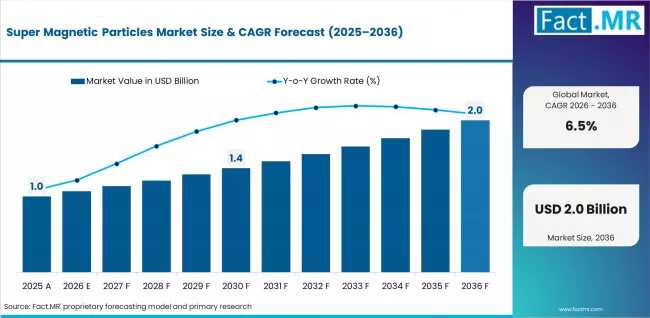
ROCKVILLE, MD, UNITED STATES, March 30, 2026 /EINPresswire.com/ -- The global super magnetic particles market is undergoing a structural transformation, evolving from specialized laboratory reagents into mission-critical components for high-throughput clinical workflows. Valued at USD 1.02 billion in 2025, the market is projected to climb to USD 1.09 billion in 2026, eventually reaching a valuation of USD 2.04 billion by 2036.This trajectory represents a steady 6.5% CAGR, creating an absolute dollar opportunity of USD 0.95 billion over the next decade. The primary catalyst is the accelerating adoption of magnetic bead-based assay platforms, which are replacing traditional centrifugation-based separation in pharmaceutical research and clinical diagnostics to achieve faster, automated sample processing.
For Details Deep insights, Please Request A sample report for Free https://www.factmr.com/connectus/sample?flag=S&rep_id=7439
Market Dynamics: The Shift to Functionalized Precision
Super magnetic particles—engineered micro- and nanoscale particles that exhibit superparamagnetic behavior—allow for rapid magnetic separation without leaving residual magnetization. This ""zero-remanence"" property is vital for delicate biomedical applications where particle aggregation could compromise results.
Dominant Material: Iron Oxide Nanoparticles lead the market with a 58.0% share in 2026. Their popularity stems from an optimal balance of magnetic response, biocompatibility, and surface functionalization versatility.
Leading Application: Biomedical Separation & Assays command 39.0% of the market. The structural shift toward automated clinical testing and nucleic acid isolation is driving bulk procurement by diagnostic giants.
Surface Engineering: Silica/Biopolymer-Coated particles hold a 62.0% share, as these coatings enable the stable covalent attachment of antibodies, proteins, and nucleic acid probes required for targeted assays.
Quick Stats: Global Growth Outlook (2026–2036)
Metric Details
Market Value (2026) USD 1.09 Billion
Projected Value (2036) USD 2.04 Billion
CAGR (2026-2036) 6.5%
Top Growing Country USA (7.9% CAGR)
Dominant Segment Iron Oxide Nanoparticles (58% Share)
Regional Leadership: North America and Europe Set the Pace
The United States is the primary engine of growth, expanding at a 7.9% CAGR. This is fueled by a robust biotechnology infrastructure in hubs like Boston and San Francisco, where magnetic particles are now standard in drug discovery and cell therapy workflows.
In Europe, Germany leads with a 29.3% market share, followed closely by the UK and France. The European market is characterized by a high demand for ISO 13485 certified particles, as diagnostic kit manufacturers prioritize regulatory compliance and batch-to-batch reproducibility.
Mexico (7.2% CAGR) and South Korea (5.9% CAGR) are emerging as high-growth corridors, driven by the expansion of pharmaceutical contract research operations and a surge in biosensor manufacturing.
For instant access to this report, click "Buy Now" or connect with our analyst for customization: https://www.factmr.com/checkout/7439
Strategic Imperatives for Decision Makers
For stakeholders in the life sciences and industrial sensor sectors, the transition to super magnetic particles is no longer optional—it is a requirement for scalability. Success in this technology-intensive category is defined by:
Particle Functionalization Expertise: Moving beyond ""off-the-shelf"" beads to custom bioconjugation (streptavidin, antibody-specific) to enhance assay sensitivity.
Quality-by-Design: Adopting advanced synthesis systems that ensure consistent biocompatibility and magnetic uniformity.
Integrated Workflows: Transitioning from individual component sourcing to complete magnetic systems that include particles, separation procedures, and technical documentation.
While the market faces restraints such as high initial costs for smaller institutions and competition from microfluidics, the trend toward theranostics (combined therapy and diagnostics) and nanotechnology integration is expected to keep demand high through 2036.
Related Market Intelligence Reports
Sodium Hypochlorite Market https://www.factmr.com/report/sodium-hypochlorite-market
Sodium Sulphite Market https://www.factmr.com/report/1365/sodium-sulphite-market
Sodium Chlorate Market https://www.factmr.com/report/2357/sodium-chlorate-market
Sodium Lignosulfonate Market https://www.factmr.com/report/sodium-lignosulfonate-market
About Fact.MR:
Fact.MR is a leading provider of market intelligence and consulting services, offering data-driven insights into over 150 global markets including healthcare, industrial automation, and specialty chemicals.
S. N. Jha
Fact.MR
+1 628-251-1583
email us here
Legal Disclaimer:
EIN Presswire provides this news content "as is" without warranty of any kind. We do not accept any responsibility or liability for the accuracy, content, images, videos, licenses, completeness, legality, or reliability of the information contained in this article. If you have any complaints or copyright issues related to this article, kindly contact the author above.
