

U.S. Retail Pharmacy Market to Reach US$ 901.4 Bn by 2032 | Persistence Market Research
U.S. retail pharmacy market
Overview of the U.S. retail pharmacy market, highlighting trends, growth drivers, digital transformation, and evolving healthcare services landscape.
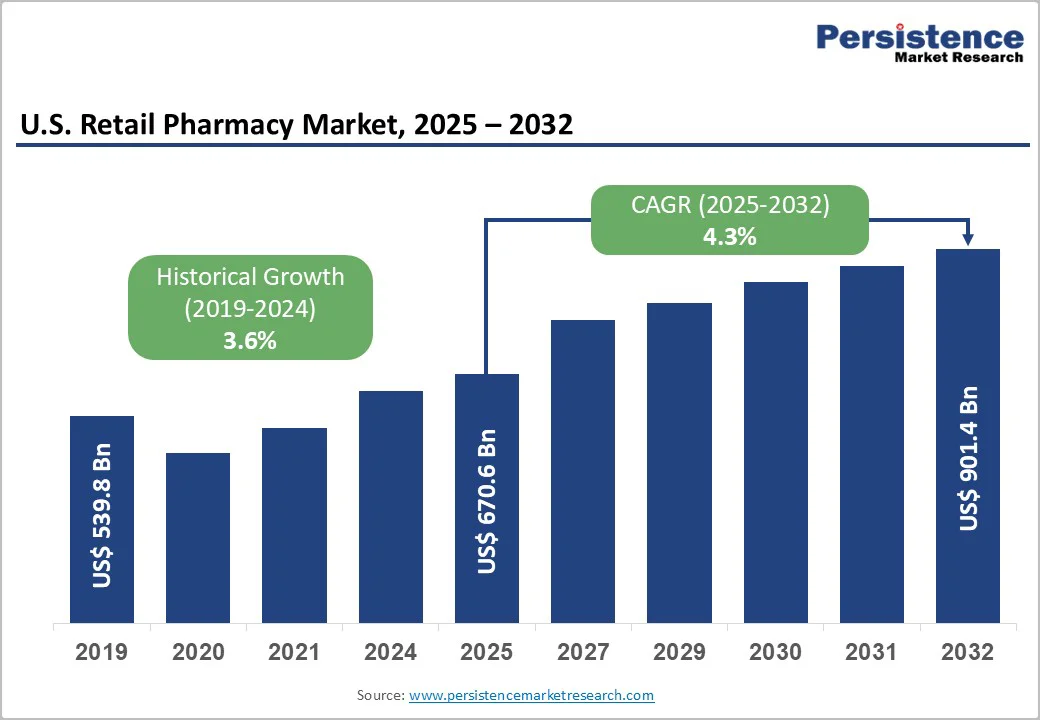
LONDON, UNITED KINGDOM, April 1, 2026 /EINPresswire.com/ -- The U.S. retail pharmacy market is a critical component of the broader healthcare ecosystem, evolving rapidly to meet changing consumer needs and technological advancements. The market is estimated to reach US$ 670.6 billion in 2025 and is projected to grow to US$ 901.4 billion by 2032, expanding at a compound annual growth rate (CAGR) of 4.3%. This steady growth reflects increasing demand for pharmaceutical services, driven by demographic shifts, rising chronic disease prevalence, and digital transformation.
Retail pharmacies have moved beyond their traditional role of dispensing medications to become comprehensive healthcare hubs. Their importance was highlighted during the COVID-19 pandemic, when they played a central role in vaccination campaigns. Today, pharmacies provide services such as immunizations, medication therapy management (MTM), and chronic disease monitoring, contributing significantly to improved patient outcomes and reduced hospital admissions.
Download Your Free Sample & Explore Key Insights: https://www.persistencemarketresearch.com/samples/34971
Key Market Drivers
One of the primary growth drivers is the increasing adoption of digital pharmacies and home delivery services. With widespread internet penetration in the United States, consumers are increasingly prioritizing convenience and accessibility. E-commerce and same-day delivery models are transforming how medications are distributed, making it easier for patients to access prescriptions without visiting physical stores.
Additionally, the rising burden of chronic diseases such as diabetes, cardiovascular disorders, and cancer is fueling demand for long-term medication. A growing aging population further supports this trend, as older adults typically require continuous pharmaceutical care. This demographic shift ensures sustained demand for prescription drugs and pharmacy services across the country.
Market Restraints
Despite strong growth prospects, the market faces several challenges. Consolidation among large pharmacy chains has intensified competition, placing pressure on smaller independent pharmacies. Financial strain, store closures, and reduced reimbursement rates are affecting profitability across the sector.
Pharmacy Benefit Managers (PBMs) also exert significant control over drug pricing and distribution, often limiting transparency and reducing margins for retail pharmacies. High out-of-pocket costs for patients and regulatory complexities related to drug approvals and recalls further hinder market expansion.
Emerging Opportunities
The expansion of digital health platforms, mail-order pharmacies, and AI-driven solutions presents significant opportunities. Increasing smartphone usage and the shift toward online healthcare services have accelerated the adoption of ePharmacies. Consumers are showing a growing preference for online platforms due to affordability, convenience, and improved access to medications.
Automation and robotics are also transforming pharmacy operations. These technologies enhance dispensing accuracy, reduce labor costs, and improve efficiency. As pharmacies continue to integrate advanced technologies, they are better positioned to deliver high-quality, patient-centric services.
Another promising area is personalized medicine and pharmacogenomics. Advances in biotechnology enable pharmacies to tailor treatments based on individual genetic profiles, improving medication effectiveness and patient adherence. This shift toward precision healthcare is expected to create new revenue streams and strengthen the role of pharmacies in patient care.
Get Custom Insights Designed for Your Businecss: https://www.persistencemarketresearch.com/request-customization/34971
Category-wise Insights
By pharmacy type, chain pharmacies dominate the market, accounting for 58.2% of total revenue. Their extensive networks, strong brand presence, and integrated digital capabilities give them a competitive advantage. Meanwhile, mail-order and online pharmacies are gaining traction, reshaping consumer preferences and expanding access.
In terms of prescription type, prescription drugs hold the largest share at 54.7%, driven by increasing chronic disease cases and the need for long-term treatment. Pharmacies are enhancing patient engagement through adherence programs and integrated care models, further boosting prescription volumes.
By product category, generic drugs lead the market with a 67.2% share. Their affordability and widespread availability make them a preferred choice for both patients and providers. Generics account for a significant portion of prescriptions dispensed, offering substantial cost savings while maintaining therapeutic effectiveness.
Regional and Competitive Landscape
Regionally, demand varies across the United States. Urban areas benefit from advanced healthcare infrastructure and higher pharmacy spending, while rural regions rely more on independent and mail-order pharmacies. Certain areas continue to face challenges related to limited access, often referred to as pharmacy deserts.
The competitive landscape is dominated by large corporations that continue to expand their physical and digital presence. Companies are investing in telehealth, digital prescription systems, and strategic partnerships to enhance service delivery and improve customer experience. These initiatives are helping pharmacies remain competitive in an increasingly dynamic market.
Checkout Now & Download Complete Market Report: https://www.persistencemarketresearch.com/checkout/34971
U.S. Retail Pharmacy Market Segmentation
By Pharmacy Type
Chain Pharmacies
Independent Pharmacies
Hospital Pharmacies
Mail Order & Online Pharmacies
By Prescription Type
Prescription Drugs (Rx)
Over-the-Counter (OTC) Drugs
By Product
Generic Drugs
Branded Drugs
By Zone
U.S.
West U.S.
Midwest U.S.
Southwest U.S
Southeast U.S.
Northeast U.S.
Conclusion
The U.S. retail pharmacy market is undergoing significant transformation, driven by digital innovation, demographic trends, and evolving consumer expectations. While challenges such as pricing pressures and market consolidation persist, opportunities in technology integration, personalized medicine, and online services are shaping the future of the industry. As pharmacies continue to expand their role in healthcare delivery, they are poised to remain essential players in improving access, affordability, and patient outcomes nationwide.
Read Related Reports:
Tumour-Induced Osteomalacia Market: The Tumour-Induced Osteomalacia market is projected to grow from US$ 126.8 Million in 2026 to US$ 208.3 Million by 2033, at a CAGR of 5.4%.
Post Herpetic Neuralgia Treatment Market: The global post-herpetic neuralgia treatment market is projected to grow from US$925.6 million in 2026 to US$1,355.4 million by 2033, at a CAGR of 5.6%.
Persistence Market Research
Persistence Market Research Pvt Ltd
+1 646-878-6329
email us here
Visit us on social media:
LinkedIn
Instagram
Facebook
YouTube
X
Legal Disclaimer:
EIN Presswire provides this news content "as is" without warranty of any kind. We do not accept any responsibility or liability for the accuracy, content, images, videos, licenses, completeness, legality, or reliability of the information contained in this article. If you have any complaints or copyright issues related to this article, kindly contact the author above.
