

[Latest] Food Traceability Technology Market Size Expected to Reach USD 46.27 Billion by 2034, With 7.86% CAGR; Growing Awareness About Protecting Public Health and Stringent Regulatory Requirements for Food Safety to Propel Market Growth
NEW YORK, USA, July 17, 2026 (GLOBE NEWSWIRE) -- Zion Market Research has published a new research report titled “Food Traceability Technology Market By Technology Type (Global Positioning Systems, Biometrics, Infrared, Barcodes, Radio Frequency Identification, and Others), By Application (Fish, Meat & Seafood, Fruit Pulp & Concentrates, Fruits & Vegetables, Processed Food, Dairy Products, Bakery & Confectionery, and Others), By Software (Enterprise Resources Planning (ERP), Friction Welding, Laboratory Information Systems, Warehouse Software, Supply Chain Management (SCM), and Others), and By Region - Global and Regional Industry Overview, Market Intelligence, Comprehensive Analysis, Historical Data, and Forecasts 2025 - 2034” in its research database.
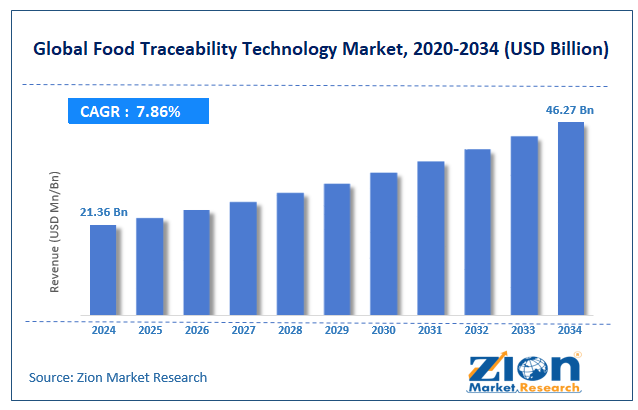
“According to the latest research study, the global food traceability technology market size was valued at around USD 21.36 billion in 2024. The market is expected to grow at a CAGR of 7.86% and is anticipated to reach a value of USD 46.27 billion by 2034.”
Get a Free Sample PDF of this Research Report for more Insights - https://www.zionmarketresearch.com/sample/food-traceability-technology-market
Food Traceability Technology Market Overview:
Food traceability technology refers to a set of solutions used for tracking food product movement from origin until it reaches the end-customers. The primary objective of food tracing is to determine the origin of the food product, along with information on the entire supply chain of the item, including storage and distribution. One of the main advantages of food tracing is to identify and mitigate risks related to food safety. Food traceability technologies are of different types, with each form offering certain advantages over others. The most commonly used technologies for food tracing include radio-frequency identification (RFID) tags, barcode scanning, and blockchain technology. During the forecast period, demand for food traceability technology is expected to continue growing, driven by several factors.
For instance, growing concerns among consumers regarding food origins and safety have fueled greater demand for tracing solutions. Furthermore, compliance with regulations is an additional food traceability technology market growth driver. The industry is, however, plagued with several disadvantages and challenges. Lack of standard regulations and complexity of the supply chain are some of the most prominent growth barriers reported in the industry.
Report Scope:
| Report Attribute | Report Details |
| Market Size in 2024 | USD 21.36 Billion |
| Market Forecast in 2034 | USD 46.27 Billion |
| Growth Rate | CAGR of 7.86% |
| Base Year | 2024 |
| Forecast Years | 2025- 2034 |
| Key Companies Covered | Bio-Rad Laboratories, Honeywell International, FoodLogiQ, Bext360, SAP SE, FoodDocs, rfxcel, Acsis Inc., IBM, OPTEL Group, Carlisle Technology, Zebra Technologies, iFoodDS, Trace One and Safefood 360°.Bio-Rad Laboratories, Honeywell International, FoodLogiQ, Bext360, SAP SE, FoodDocs, rfxcel, Acsis Inc., IBM, OPTEL Group, Carlisle Technology, Zebra Technologies, iFoodDS, Trace One, and Safefood 360°. |
| Segments Covered | By Technology Type, By Application, By Software, and By Region |
| Regions Covered | North America, Europe, Asia Pacific, Latin America, and the Middle East & Africa |
| Customization Scope | Avail customized purchase options to meet your exact research needs. |
Directly Purchase a Copy of the Report | Quick Delivery Available - https://www.zionmarketresearch.com/buynow/su/food-traceability-technology-market
Key Insights from Primary Research
- As per the analysis, the food traceability technology market share is likely to grow at a CAGR of around 7.86% between 2025 and 2034.
- The food traceability technology market size was worth around $21.36 billion in 2024 and is estimated to hit approximately $46.27 billion by 2034. Due to a variety of driving factors, the market is predicted to rise at a significant rate.
- The market is projected to grow at a significant rate due to the growing awareness about protecting public health and stringent regulatory compliance requirements.
- Based on technology type, the barcodes segment dominates and is growing at a high rate due to its cost-effectiveness and performance efficiency.
- Based on application, the fish, meat & seafood segment commands the largest market share, driven by consumer demand and regulatory pressure on these products.
- Based on software, the supply chain management (SCM) segment leads due to its critical role in end-to-end visibility and integration.
- Based on region, North America dominates the global market share owing to strict regulatory environments and a high focus on food safety recalls.
Food Traceability Technology Market: Dynamics
Growth Drivers
How will growing awareness about protecting public health influence the food traceability technology market growth?
The global food traceability technology market is expected to be driven by the growing awareness about protecting public health. Food traceability technologies are designed to ensure the quality and safety of food products. They are helpful in the rapid identification and subsequent recall of unsafe or contaminated food products. Tracking the entire food supply chain of contaminated items can help authorities identify the origin of the food product and remove it from the commercial markets. In recent years, the number of incidents related to food-borne illnesses has increased across the globe.
In addition, strict regulatory guidelines and compliance requirements push for improved revenue in the industry. Several countries worldwide have strict regulatory guidelines ensuring food safety. These guidelines are designed to prevent public health issues and are highly comprehensive. They cover several aspects of food products, including origin, production, storage, and distribution. Food traceability technologies allow companies and brands to comply with regional requirements and maintain food standards to avoid legal action. Companies can demonstrate compliance using technologies that store information related to each step of the food supply chain.
Restraints
What will be the impact of the lack of standardization on the food traceability technology market?
The global food traceability technology industry is expected to be restricted due to the lack of standardization in the food sector. At present, the industry lacks the presence of a global standard for food traceability as the laws and regulations differ from one country to another. This leads to severe confusion among food companies as they cannot implement one procedure for all markets and must comply with multiple standards.
This fragmentation increases implementation costs and complexity, slowing widespread adoption, particularly among smaller players in the supply chain.
Opportunities
Integration of blockchain and other advanced technologies to create market growth possibilities for the industry players
The global food traceability technology market is expected to generate growth opportunities due to the rising use of blockchain and other advanced solutions. According to industry analysis, food traceability technology providers are actively investing in developing blockchain solutions to create a secure and transparent record of the food product’s supply chain and overall journey. The digital ledger thus created cannot be changed without proper approval. Furthermore, industry players are also seeking other cutting-edge engineering solutions to improve the performance of food traceability technologies.
Partnerships and innovations in real-time visibility tools further enhance adoption across complex global supply chains.
Challenges
Why will supply chain complexity emerge as a critical challenge in the food traceability technology industry?
The global food traceability technology industry is expected to be challenged by the supply chain complexity in the food industry. Food products tend to pass through multiple middlemen, including distributors and final retailers. Tracking food items through the complex web of intermediaries can be challenging. Additionally, food products have witnessed increased globalization, which means that the items may be produced and sold across multiple countries. This can further create growth barriers against the market players.
Data integration across diverse systems and ensuring accuracy in multi-country operations add layers of difficulty.
Browse the full “Food Traceability Technology Market By Technology Type (Global Positioning Systems, Biometrics, Infrared, Barcodes, Radio Frequency Identification, and Others), By Application (Fish, Meat & Seafood, Fruit Pulp & Concentrates, Fruits & Vegetables, Processed Food, Dairy Products, Bakery & Confectionery, and Others), By Software (Enterprise Resources Planning (ERP), Friction Welding, Laboratory Information Systems, Warehouse Software, Supply Chain Management (SCM), and Others), and By Region - Global and Regional Industry Overview, Size, Trends, Market Intelligence, Comprehensive Analysis, Historical Data, and Forecasts 2025 - 2034” Report at https://www.zionmarketresearch.com/report/food-traceability-technology-market
Food Traceability Technology Market: Segmentation
The food traceability technology market is segmented by technology type, application, software, and region.
Based on Technology Type, the food traceability technology market is divided into global positioning systems, biometrics, infrared, barcodes, radio frequency identification, and others. The barcodes segment is the most dominant due to its cost-effectiveness, ease of implementation, and high performance efficiency, making it widely adopted across various stages of the food supply chain. It drives the market by enabling quick scanning and data capture that supports efficient tracking and inventory management at low operational costs. Its widespread integration in packaging and retail environments accelerates overall market penetration and supports regulatory compliance efforts. The radio frequency identification (RFID) segment is the second most dominant. It offers advanced real-time tracking capabilities and greater data storage, helping drive the market through applications requiring detailed monitoring in complex logistics networks.
Based on Application, the food traceability technology market is divided into fish, meat & seafood, fruit pulp & concentrates, fruits & vegetables, processed food, dairy products, bakery & confectionery, and others. The fish, meat & seafood segment is the most dominant, accounting for the largest share due to high consumer demand, stringent safety regulations, and frequent risks of contamination in these perishable categories. It drives the market by necessitating robust tracking systems for rapid recalls and origin verification, enhancing public health protection. The processed food segment is the second most dominant. Growing consumption of ready-to-eat items and complex supply chains for ingredients propel demand for comprehensive traceability to maintain quality and brand trust.
Based on Software, the food traceability technology market is divided into enterprise resource planning (ERP), friction welding, laboratory information systems, warehouse software, supply chain management (SCM), and others. The supply chain management (SCM) software segment is the most dominant as it provides end-to-end visibility, integration, and analytics critical for managing complex food logistics. It drives the market by enabling proactive risk management and efficiency improvements across global operations. The enterprise resource planning (ERP) segment is the second most dominant, supporting seamless data flow and compliance reporting that strengthens overall system interoperability.
Regional Scope:
Why will North America continue to dominate the global market during the projection period?
The global food traceability technology market is expected to be led by North America. The presence of a strict regulatory environment concerning food safety is one of the leading reasons for regional dominance. The region has reported several food recall incidents in the past few years. These timely recalls are made possible using food traceability technology. The United States drives much of the demand through agencies like the FDA enforcing rigorous standards. Canada also contributes with a strong focus on agricultural exports and safety protocols.
Asia-Pacific is expected to register the fastest growth. Growing regional concerns over food safety across prominent Asian countries will promote expansion. The region is one of the largest consumers of food products with a complex regional supply chain. China and India are key markets due to expanding food industries and rising compliance needs. Japan, South Korea, and Southeast Asian nations further support demand through technological adoption and export requirements. Europe maintains steady growth with an emphasis on transparency and sustainability in food chains. Latin America and the Middle East & Africa show emerging potential from improving regulations and export-oriented agriculture.
Recent Developments
- In April 2025, SGS announced a partnership with TRAKKEY by ENSESO4Food to integrate next-generation traceability technology for real-time supply chain visibility.
- In September 2025, the Global Food Traceability Center of IFT launched an open-source tool called the Traceability Driver for standardized data compliance.
- In November 2025, multiple recalls highlighted the critical role of advanced traceability systems in addressing contamination issues.
Request for Customization on This Report as Per Your Requirements - https://www.zionmarketresearch.com/custom/10187
Food Traceability Technology Market: Competitive Landscape
The report contains qualitative and quantitative research on the global food traceability technology market, as well as detailed insights and development strategies employed by the leading competitors.
Some of the main players in the global food traceability technology market include;
- Bio-Rad Laboratories
- Honeywell International
- FoodLogiQ
- Bext360
- SAP SE
- FoodDocs
- rfxcel
- Acsis Inc.
- IBM
- OPTEL Group
- Carlisle Technology
- Zebra Technologies
- iFoodDS
- Trace One
- Safefood 360°
The global food traceability technology market is segmented as follows:
What are the key trends in the Food Traceability Technology Market?
Improvements in the supply chain
Food traceability technologies assist in improving supply chain efficiency. They are helpful in early identification of gaps in the supply chain and help improve aspects such as storage conditions while reducing transportation times.
Growing focus on enhancing consumer trust
The surge in the number of food product providers worldwide has resulted in greater demand for technologies that help enhance consumer trust. Additionally, rising health awareness among end-buyers will fuel adoption of food traceability technology to enhance transparency in the food supply chain.
The global food traceability technology market is segmented as follows:
By Technology Type
- Global Positioning Systems
- Biometrics
- Infrared
- Barcodes
- Radio Frequency Identification
- Others
By Application
- Fish, Meat & Seafood
- Fruit Pulp & Concentrates
- Fruits & Vegetables
- Processed Food
- Dairy Products
- Bakery & Confectionery
- Others
By Software
- Enterprise Resource Planning (ERP)
- Friction Welding
- Laboratory Information Systems
- Warehouse Software
- Supply Chain Management (SCM)
- Others
By Region
- North America
- The U.S.
- Canada
- Europe
- France
- The UK
- Spain
- Germany
- Italy
- Rest of Europe
- Asia Pacific
- China
- Japan
- India
- Southeast Asia
- Rest of Southeast Asia
- The Middle East & Africa
- GCC
- South Africa
- Rest of the Middle East & Africa
- Latin America
- Brazil
- Argentina
- Rest of Latin America
Request Free Brochure of the Global Food Traceability Technology Market @ https://www.zionmarketresearch.com/requestbrochure/food-traceability-technology-market
Key Questions Answered in This Report:
- What is food traceability technology?
- What are the key growth drivers of the food traceability technology Market?
- What will be the value of the food traceability technology market during 2025-2034?
- What will be the CAGR value of the food traceability technology market during 2025-2034?
- What are the major challenges restraining the growth of the food traceability technology market?
- Which application areas will offer significant growth opportunities in the food traceability technology market?
- What are the emerging trends and innovations impacting the food traceability technology market?
- Which region will contribute notably towards the food traceability technology market value?
- Which are the major players leveraging the food traceability technology market growth?
- What can be expected from the global food traceability technology market report?
Browse Other Related Research Reports from Zion Market Research
- ERP Software Market By Deployment (On-premise and Cloud), By Function (Finance, Supply Chain, HR, and Others), By Enterprise Size (Large Enterprises, Small Enterprises, and Medium Enterprises), By Industry Vertical (Manufacturing & Services, Healthcare, Retail, Telecom, Aerospace & Defense, BFSI, Government, and Others), and By Region - Global and Regional Industry Overview, Market Intelligence, Comprehensive Analysis, Historical Data, and Forecasts 2026 - 2034
- Smart Shelves Market By Component (Hardware, Services, and Software), By Application (Planogram Management, Content Management, Pricing Management, Inventory Management, and Others), By End-use (Hypermarkets, Department Stores, Warehouses, Supermarkets, and Others), and By Region - Global and Regional Industry Overview, Market Intelligence, Comprehensive Analysis, Historical Data, and Forecasts 2026 - 2034
- Credit Card Payments Market By Card Type (Standard Credit Cards, Reward Credit Cards, Premium Credit Cards, and Secured Credit Cards), By Provider Type (Banks, Fintech Companies, and Non-Bank Financial Institutions), By Usage Category (Travel, Healthcare, Retail, Education, and Dining), By Transaction Type (In-Store Payments, Mobile Payments, and Online Payments), and By Region - Global and Regional Industry Overview, Market Intelligence, Comprehensive Analysis, Historical Data, and Forecasts 2026 - 2034
- Smart Travel Sector Market By Solution (Smart Ticketing, Smart City Bots, Smart Parking, Smart Security Services, and Others), By Booking Channel (Phone Booking, In-Person Booking, and Online Booking), By Tourism Type (Domestic and International), By Tourist Type (Independent Traveler, Package Traveler, and Tour Group), and By Region - Global and Regional Industry Overview, Market Intelligence, Comprehensive Analysis, Historical Data, and Forecasts 2026 - 2034
- Smart Vase Market By Material Type (Metal, Plastic, Glass, Ceramic, and Others), By Application (Residential and Commercial), By Distribution Channel (Online and Offline), and By Region - Global and Regional Industry Overview, Market Intelligence, Comprehensive Analysis, Historical Data, and Forecasts 2026 - 2034
About Zion Market Research:
Zion Market Research is a leading market research organization offering industry expertise and scrupulous consulting services to clients for their business development. The reports and services offered by Zion Market Research are used by prestigious academic institutions, start-ups, and companies globally to measure and understand the changing international and regional business backgrounds.
Contact Us:
Zion Market Research
USA/Canada Toll Free: 1 (855) 465-4651 | Newark: 1 (302) 444-0166
India: +91 7768 006 007 | +91 7768 006 008
Email: sales@zionmarketresearch.com | Web: https://www.zionmarketresearch.com/
Follow Us on - LinkedIn | X | Facebook | Pinterest | YouTube


Legal Disclaimer:
EIN Presswire provides this news content "as is" without warranty of any kind. We do not accept any responsibility or liability for the accuracy, content, images, videos, licenses, completeness, legality, or reliability of the information contained in this article. If you have any complaints or copyright issues related to this article, kindly contact the author above.
